Though Inside Job took home the prize for Best Documentary at last night's Academy Awards, a cloud of controversy surrounded the prospects of another documentary nominee, Exit Through the Gift Shop.
This film was directed by the enigmatic British artist Banksy, whose anonymity is one of his greatest claims to fame. A few days before the awards took place, it was announced that the Oscar ceremony planners would not allow Banksy to accept his award anonymously.
This being the case, I was eagerly rooting for Exit Through the Gift Shop's victory last night, if only to see what sort of shenanigans the snubbed artist would get up to. Justin Timberlake's presentation quips centered around claiming that he was Banksy, though most members of the audience didn't seem to understand the joke. The Onion even got in on the fun, tweeting "Don’t recognize the person 9 rows up, 15 seats in. Must be Banksy" midway through the ceremony.
So, for the vast majority of you that haven't seen this film (available now on dvd and Netflix instant streaming): What is this movie about, for it to cause such a stir?
Exit Through the Gift Shop begins by detailing the life of one Thierry Guetta, a French immigrant and family man with an obsession with capturing life on film. He records the world around him at every opportunity, using up handfuls of tapes a day. He hardly ever goes back and watches these tapes; his only care is that life is recorded, and doesn't feel the need to relive it. Through a family relation that calls himself Space Invader, Guetta is introduced to the underground world of street art. By following his cousin around the city late into the night as he creates his graffiti work, Guetta finds a focus for his filming obsession.
Over a period of months Guetta accompanies handfuls of street artists, filming their exploits under the pretense of gathering material to make a documentary about street art. In reality, making something out of his recordings was the last thing on Guetta's mind. Eventually, he encounters the gold standard of street artists, Banksy, who takes Guetta under his wing.
After documenting many Banksy's exploits, Guetta is encouraged to go off and try to create art on his own. After discovering that Guetta had no intention of making his documentary, Banksy took it upon himself to craft the film, in the end making Thierry Guetta the film's true focus. The film's final act, which documents Guetta's gradual metamorphosis into the hyped-up artistic phenomenon Mr. Brainwash, ultimately raises these fundamental questions: what is art, and can anyone create it?
The film portrays attendees of art conventions as individuals who can't recognize true art, and who are incredibly susceptible to hype and media suggestion. Even Exit Through the Gift Shop's title is indicative of one of the film's major themes: the commercialization and over-saturation of what was once a legitimate and personal underground art movement.
To protect the provocative impact of the film itself, I will leave my commentary at that. Since the film's release, it has stirred up wild rumors and controversy over whether parts of the film were staged, or even whether the entire documentary is an elaborate hoax masterminded by Banksy. Judge for yourself: hoax or no, Exit Through the Gift Shop is a poignant and multi-facetted look at the world of artistic expression and commercialization that kept me thinking for weeks after I viewed it.
A blog about cinema, literature, video games and more-- A thoughtful discussion on the art of storytelling.
Showing posts with label Reviews. Show all posts
Monday, February 28, 2011
Monday, February 21, 2011
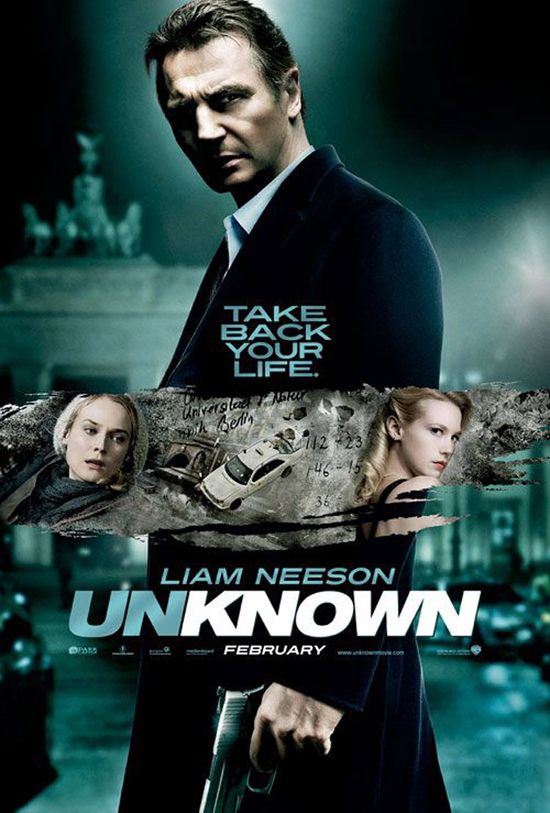
(REVIEW) Unknown: Uninspired
I must admit, I have a bit of a soft spot for Liam Neeson. I was first became aware of him in fourth grade. He was introduced to me in the manner most likely to grab my idolizing attention as an elementary schooler: I saw him play a jedi onscreen. Though my taste in prequels as a wee lad of 10 was somewhat questionable, I retain a certain fondness for Liam Neeson's work. You've got to harbor a little respect for a man with the versatility to portray Jean Valjean, Oskar Schindler, Alfred Kinsey, Zeus, Aslan, and Ra's al Ghul. Recently, he's become more and more the action hero, starring in 2008's warmly recieved Taken and the critically-panned The A-Team reboot. In Unknown he continues this trend, starring in what turns out to be a derivate amnesia tale with just barely enough interesting twists to make it watchable.
The movie opens with Dr. Martin Harris (Liam Neeson) arriving in Berlin to attend a conference with his wife, Elizabeth (January Jones). On his way back to the airport to retrieve some forgotten luggage, Harris' taxi is forced off a bridge and suffers a head injury, erasing any recollection of the days events from his mind and putting him in a coma for four days. When he returns the hotel to find his wife, he finds that she does not recognize him, and that she is accompanied by a man claiming to be the real Dr. Martin Harris. Harris's memories of his past life are thrown into question, and he sets out to discover who he really is.
This first half-hour is the film's highpoint, in which Harris questions his identity and becomes increasingly paranoid about prying eyes, both real and imaged. Once Harris discovers that people are indeed out to get him, the plot becomes formulaic and plays out similarly to The Bourne Identity. Just as in The Bourne Identity, Harris quickly picks up a young female sidekick, and among car chases and small apartment stand-offs the conspiracy-riddled plot is eventually uncovered.
Neeson sells the role right off the bat, but seems like he's trying too hard at intensity in several scenes. His emotional scale for all intents and purposes has two settings in this movie-- he's either calm and determined or barking out lines in a gravel-gargling rage. Diane Kruger and Bruno Ganz play excellent supporting roles as illegal citizen Gina and Ernst Jurgen, respectively. January Jones' portrayal of Mrs. Harris, however, is wooden and unconvincing. When she attests that she's never seen her husband before, you don't believe her for a second, causing twists later on in the film to lose their dramatic impact.
The film works in several red herrings and acts of misdirection that will most likely keep viewers on their toes, and it manages to do this while not letting these twists muddle up the story. Sadly, many of the action sequences are sprinkled with unintentionally humorous moments that break the dramatic tension, such as cars that unnecessarily burst into flames or lines of dialogue where Neeson is trying way too hard to maintain an American accent.
Despite its occasional moments of surprise, Unknown feels a little to derivative of other popular films in its bloated genre. Neeson's star power helps keep the movie afloat, but don't expect to be walk out of the theater wowed by either its plot or presentation. I'd recommend skipping the film in theaters. Save it for a rainy-day Netflix viewing.
Sunday, February 13, 2011
(REVIEW) The Eagle: Generic, but Enjoyable
Capitalizing on the recent resurgence of sword-and-sandal dramas like Spartacus: Blood and Sand, Oscar-winning director Kevin Macdonald puts forth The Eagle, the genre's latest entry. Though the film gets off to a rocky start, about twenty minutes in the plot picks up enough momentum to make The Eagle an entertaining but far-too-predictable adventure.
The movie begins with centurion Marcus Aquila (Channing Tatum) taking command of a backwater outpost near the northern reaches of Roman-controlled Britain. At first it's jarring to hear so many American accents among the warriors, the most guilty culprits being Tatum and his character's right-hand man, Lutorious (Denis O'Hare). Additionally, many of the actors look a little too well-groomed to be gritty soldiers posted at a neglected outpost. Luckily these minor annoyances mostly fade away as the movie goes on.
Soon after Marcus' arrival the local tribes of northern Britain attack the outpost, leaving Marcus injured and relieved of his duty. In order to regain the honor of his family's name, Marcus resolves to go deep into enemy territory to recover the symbol of his legion, the Eagle of the Ninth, which was lost by his father in a battle many years before. Traveling with him is British slave Esca (Jamie Bell), who has sworn an oath to protect Marcus and guide him through the wild lands of Caledonia.
Tatum has the screen presence to pull off leading-man roles, though the inevitable daunting comparisons to Russell Crow and Gladiator may belabor his critical reception. Bell gives a surprisingly dynamic role as Esca. Watching the pair react to the constantly-changing attitudes and situations of their characters is one of the film's most compelling aspects. This chemistry between Tatum and Bell, as well as a strong supporting role played by Donald Sutherland, helps give a little meat to the bare-bones plot.
Sadly, like all-too-many modern action movies, the action sequences are filmed in a shaky-cam style with plenty of extreme closeups. Most of the battle sequences bleed together because of this, with little to distinguish one from another. The action simply moves past the camera too fast to adequately communicate what is going on. One notable exception is a scene toward the beginning of the film where Marcus and his soldiers deploy a phalanx maneuver in a rescue mission. The bodies of the native tribes crash against the Roman shields haphazardly, and for a few moments the scene seems to strip away the romanticized depictions of battle moviegoers are used to and evoking the confusion and chaos of real conflict.
As for Marcus and Esca's journey to recover to recover the Eagle of the Ninth, there are very few surprises in store. Their bond is tested, strained, and ultimately reconciled. It is a tale about the shades of gray that all cultures fall into; no group of people is wholly good or evil. Strangely, the concept of honor in battle is portrayed as both wasteful and something to aspire toward; the film's message becomes a little confused by the end.
All in all, there is nothing inherently flawed about The Eagle; it is simply too formulaic to be outstanding. If you're a fan of the genre, check out the film. Otherwise, pass on it for now-- it may make a good DVD rental in a couple of months.
The movie begins with centurion Marcus Aquila (Channing Tatum) taking command of a backwater outpost near the northern reaches of Roman-controlled Britain. At first it's jarring to hear so many American accents among the warriors, the most guilty culprits being Tatum and his character's right-hand man, Lutorious (Denis O'Hare). Additionally, many of the actors look a little too well-groomed to be gritty soldiers posted at a neglected outpost. Luckily these minor annoyances mostly fade away as the movie goes on.
Soon after Marcus' arrival the local tribes of northern Britain attack the outpost, leaving Marcus injured and relieved of his duty. In order to regain the honor of his family's name, Marcus resolves to go deep into enemy territory to recover the symbol of his legion, the Eagle of the Ninth, which was lost by his father in a battle many years before. Traveling with him is British slave Esca (Jamie Bell), who has sworn an oath to protect Marcus and guide him through the wild lands of Caledonia.
Tatum has the screen presence to pull off leading-man roles, though the inevitable daunting comparisons to Russell Crow and Gladiator may belabor his critical reception. Bell gives a surprisingly dynamic role as Esca. Watching the pair react to the constantly-changing attitudes and situations of their characters is one of the film's most compelling aspects. This chemistry between Tatum and Bell, as well as a strong supporting role played by Donald Sutherland, helps give a little meat to the bare-bones plot.
Sadly, like all-too-many modern action movies, the action sequences are filmed in a shaky-cam style with plenty of extreme closeups. Most of the battle sequences bleed together because of this, with little to distinguish one from another. The action simply moves past the camera too fast to adequately communicate what is going on. One notable exception is a scene toward the beginning of the film where Marcus and his soldiers deploy a phalanx maneuver in a rescue mission. The bodies of the native tribes crash against the Roman shields haphazardly, and for a few moments the scene seems to strip away the romanticized depictions of battle moviegoers are used to and evoking the confusion and chaos of real conflict.
As for Marcus and Esca's journey to recover to recover the Eagle of the Ninth, there are very few surprises in store. Their bond is tested, strained, and ultimately reconciled. It is a tale about the shades of gray that all cultures fall into; no group of people is wholly good or evil. Strangely, the concept of honor in battle is portrayed as both wasteful and something to aspire toward; the film's message becomes a little confused by the end.
All in all, there is nothing inherently flawed about The Eagle; it is simply too formulaic to be outstanding. If you're a fan of the genre, check out the film. Otherwise, pass on it for now-- it may make a good DVD rental in a couple of months.
Subscribe to:
Posts (Atom)