Pages

Wednesday, March 2, 2011

The Longest Journey: Visual Dependence

I was a major bookworm during my K-12 schooling.  Now when I try and read something solely for pleasure, I find myself impatient, usually unable to hold my attention on the book for more than twenty minutes or so.  At first I thought this had to do with what sort of work I was doing in college.  Being an English and writing major, I tend to look more toward visual media such as movies, video games, and graphic novels for entertainment purposes.  The last thing I feel like doing after I finish my reading assignments is to pick up another book.

The more I think about it though, this impatience with written text seems to have something to do with the nature of the medium itself.  In many basic ways, books struggle to compete with the sensation of more visual media.  When you read a book, there are no visual depictions of what is playing out, you have to create them in your mind's eye.  You have to hear the voices of the characters in your head.  Movies, television, video games... they all eliminate the need for this sort of effort and imagination.  Your eyes and ears are bombarded with stimulation, easily achieving the instant gratification of being pulled into a story or world.  Experience an entire tale in two hours, not twenty.

Don't get me wrong: I love books, and I bemoan the onset of E-readers and other such devices that shift away from the classic paper-and-ink combo that has stimulated the minds of humanity for centuries.  The sad thing is, as technology improves we're conditioning ourselves to find literature less and less appealing.

What got me thinking about this actually doesn't have much to do with books at all.  However, I feel that this onset of technology hasn't just affected the way we experience books, but how we've been trained to experience storytelling itself. 

When I have free time, I'm always on the lookout for a good story, be it a book, movie, or game.  In high school, I stumbled across a TV show on the G4 network called CinemAddicts, which aired user-edited play-throughs of story-heavy video games.  Essentially, they would mash all of the game's cutscenes together into one big movie, with small bits of game-play left in to fill in the gaps.  One of these episodes focused on a game called Dreamfall: The Longest Journey.


  Once I found out the game was a sequel about ten minutes into the show I chose not to pay too much attention, even though I was interested.  I didn't want to ruin the original's story by watching part two.  Nevertheless, I filed Dreamfall away on my mental to-play list, thinking I'd look into it at a later date.

As it turns out, that "later date" was just two weeks ago, nearly four years later.  My memory of the game was jarred when I read a list of the top 10 female protagonists in video games.  April Ryan, star of the original game (The Longest Journey) was on the list.  I looked the game up on Steam, and got to playing.

Now, this game was originally released twelve years ago, during the holiday season of 1999.  The late 90's were a point of transition for many game developers.  In an attempt to do away with wall-of-text storytelling, the concept of having fully-voiced characters and cinematics was being experimented with more and more, pushing the boundaries of the technology and storage available at the time.

The Longest Journey is a point-and-click adventure game.  The game consists mostly of exploring the environment presented onscreen with your mouse, clicking on things in order to pick up objects, solve puzzles, or interact with characters.  The game is fully-voiced, but due to graphical limitations the character models do little more than gesture slightly with their arms or move their heads up and down when they speak. 

What this amounts to is that a vast majority of the game is spent listening to the story unfold while looking at mostly-static scenes:

Like so.
 I got really antsy playing this game.  I was pulled in by the story, but the presentation threw me off.  It wasn't visually-stimulating enough to hold my attention just with what was going on onscreen, and I almost always finished reading the subtitles far before the character finished delivering the line of dialogue.  I wasn't content sitting back and letting the voice actor finish reciting the line- I often went for the instant gratification, skipping past a character's line immediately after I finished reading it, forcing the narrative to move at a faster pace. 

I felt caught in a strange limbo of story experience: the scenes weren't compelling enough to sit there and watch, but were too short to warrant listening to while multitasking with some other activity.  I felt like I was cheating the voice actors by just reading the text and not listening to them deliver it... and so the only thing I could find to hold my attention on their delivery during longer scenes was to stand up and do some stretches while listening.

The story itself was rather fun and interesting, and April was a compelling character... but as with my inability to read contently for long periods of time nowadays, I found my attention drifting because the game wasn't fast-paced enough to compete with modern entertainment I've been trained to emotionally respond to.

I'm interested in getting around to playing Dreamfall and comparing the experience.  Dreamfall came out in 2006, boasting far fewer graphical limitations and a much more cinematic story presentation.  Something tells me I'll be a lot more engrossed.  And I'm a little ashamed.

Monday, February 28, 2011

(REVIEW) Exit Through the Gift Shop

Though Inside Job took home the prize for Best Documentary at last night's Academy Awards, a cloud of controversy surrounded the prospects of another documentary nominee, Exit Through the Gift Shop.


 This film was directed by the enigmatic British artist Banksy, whose anonymity is one of his greatest claims to fame.  A few days before the awards took place, it was announced that the Oscar ceremony planners would not allow Banksy to accept his award anonymously.

This being the case, I was eagerly rooting for Exit Through the Gift Shop's victory last night, if only to see what sort of shenanigans the snubbed artist would get up to.  Justin Timberlake's presentation quips centered around claiming that he was Banksy, though most members of the audience didn't seem to understand the joke.  The Onion even got in on the fun, tweeting "Don’t recognize the person 9 rows up, 15 seats in. Must be Banksy" midway through the ceremony.

So, for the vast majority of you that haven't seen this film (available now on dvd and Netflix instant streaming): What is this movie about, for it to cause such a stir?

Exit Through the Gift Shop begins by detailing the life of one Thierry Guetta, a French immigrant and family man with an obsession with capturing life on film.  He records the world around him at every opportunity, using up handfuls of tapes a day.  He hardly ever goes back and watches these tapes; his only care is that life is recorded, and doesn't feel the need to relive it.  Through a family relation that calls himself Space Invader, Guetta is introduced to the underground world of street art.  By following his cousin around the city late into the night as he creates his graffiti work, Guetta finds a focus for his filming obsession.

Over a period of months Guetta accompanies handfuls of street artists, filming their exploits under the pretense of gathering material to make a documentary about street art.  In reality, making something out of his recordings was the last thing on Guetta's mind.  Eventually, he encounters the gold standard of street artists, Banksy, who takes Guetta under his wing.

After documenting many Banksy's exploits, Guetta is encouraged to go off and try to create art on his own.  After discovering that Guetta had no intention of making his documentary, Banksy took it upon himself to craft the film, in the end making Thierry Guetta the film's true focus.  The film's final act, which documents Guetta's gradual metamorphosis into the hyped-up artistic phenomenon Mr. Brainwash, ultimately raises these fundamental questions: what is art, and can anyone create it?

The film portrays attendees of art conventions as individuals who can't recognize true art, and who are incredibly susceptible to hype and media suggestion.  Even Exit Through the Gift Shop's title is indicative of one of the film's major themes: the commercialization and over-saturation of what was once a legitimate and personal underground art movement.

To protect the provocative impact of the film itself, I will leave my commentary at that.  Since the film's release, it has stirred up wild rumors and controversy over whether parts of the film were staged, or even whether the entire documentary is an elaborate hoax masterminded by Banksy.  Judge for yourself: hoax or no, Exit Through the Gift Shop is a poignant and multi-facetted look at the world of artistic expression and commercialization that kept me thinking for weeks after I viewed it.

Saturday, February 26, 2011

(OT) 7 Deadly Sins- Full Metal Alchemist- Part 2

(As with the previous article, beware of spoilers.)

Greed
The first example of Greed's avaricious nature is that he defected from working alongside the other Homunculi, unwilling to share even a common goal with his brethren.  He's not very subtle about his desires, either.  When asked what his motives are during a confrontation with the Elric Brothers, he responds with a straightforward "everything".  Every action he makes is strictly for his own benefit.  Even his last act before dying, letting Edward Elric know how to defeat the other Homunculi, is a self-serving act.  If he has to die, why should any of his brethren get what they desire?

Sloth 
About midway through the series, it is revealed what became of the malformed not-quite-alive creature created by Ed and Al's failed attempt to resurrect their mother.  Shortly after the brothers left their home behind, the pitiful creature was discovered by Dante, nursed and imbued with power over time until it became Sloth.  Sloth retains the likeness of Trisha Elric, but retains no compassion for Ed and Al, claiming her apparent lack of soul gives her no desire to care about them.

Like Lust, her resemblence to the sin she is named for is not immediately apparent.  However, her apathy toward the sons of  the body she was formed from is evocative of the jaded and unconcerned manner attributed to the Slothful. 

Her supernatural power is the ability to convert her entire body into water and travel quickly from place to place.  Where were the Slothful held in Dante's Inferno?  That's right: Entombed underwater below the river Styx.

Wrath 
Alfonse and Edward discover Wrath when they return to a small island where their alchemy teacher instructed them when they were little.  He is the product of their teacher, Izumi, trying to bring her infant son back to life.  Wrath is created after Ed and Al fail to bring their mother back from the dead: Wrath's right arm and left leg are Ed's limbs that were lost during their ritual.  Wrath is the Homunculus that is quickest to mood swings and bouts of violence, and almost always speaks in a tone of subdued rage.  He is the only Homunculus capable of using alchemy, thanks to Ed's limbs.

Wrath develops a dependence on Sloth, idolizing her and making her a substitute for his mother Izumi.  Given his possession of Ed's limbs, his use of alchemy, and the fact that Sloth uses the appearance of Ed and Al's mother, Wrath can be seen as a dark reflection of Ed.  His actions reflect what would have become of Ed if Ed let his considerable temper overtake his judgment.

He is the only other Homunculus besides Lust that in some way redeems himself.  In Conquerors of Shamballa, Wrath sacrifices himself as bait to the monstrous Gluttony, giving Alfonse time to accomplish his goals.

Pride
 Fuhrer Bradley, leader of the militaristic state of Amestris that Ed and Al call home, is in reality the seventh Homunculus, Pride.

Pride can be defined as overconfidence, an inflated sense of self-worth, a belief that your own actions and solutions are ultimately justified and infallible.  Who better than a militaristic head of state to represent these qualities?

In the film sequel Conquerors of Shamballa, which partly takes place in pre-World War II Germany, the term "Fuhrer" is used blatantly to compare King Bradley (Pride) from the original series with Adolf Hitler in the film.  This comparison strengthens the already easy to spot comparisons to the prideful-to-a-sin qualities of many real-world dictators and fascists.

Closing Statement
 So there you have it: one of the most evident and contemporary examples of how powerful thematic devices can span centuries and continually be utilized in new and interesting ways. 

I hardly do the series justice in this small write-up: if anything you've read here has piqued your interest, I recommend you check out the series (it's available on Netflix instant streaming).  Unlike most anime shows I've sampled over the years, Full Metal Alchemist has a driving narrative and a decidedly Western feel to many of its episodes- if Japanese media tends to weird you out, I'd give this series a shot regardless.  Aside from several Hayao Miyazaki films (such as the superb Princess Monoke or Spirited Away), few examples of Japanese animation have gotten me as emotionally invested in the characters onscreen as Full Metal Alchemist did my first time through.

Coming up on Overanalyze That? Most likely a consideration of Se7en at some point, though I should get off this "7 Deadly Sins" series sometime soon here... it tends to get rather morbid after a while.  Thanks for reading!

Thursday, February 24, 2011

(OT) 7 Deadly Sins- Full Metal Alchemist

Background: Full Metal Alchemist

The 2003 anime series Full Metal Alchemist is perhaps the best example of the 7 Deadly Sins as a story-driving theme in a television show.  Full Metal Alchemist began as a manga series in Japan in 2001, which just recently ended its publication run last June.  In 2003 the manga was adapted into an anime that aired first in Japan before it was dubbed by Funimation and aired on Cartoon Network's Adult Swim.


This anime series eventually caught up to the manga in terms of storyline, and thus had to branch off with different writers and create their own ending to the series.  In 2009 the series rebooted as Full Metal Alchemist: Brotherhood, which recently concluded its own run and follows the story arc of the original manga, unlike the 2003 Full Metal Alchemist series.  I'm most familiar with the 2003 series, so that is what I'll focus on in my discussion.

Synopsis (Beware: from here on, there be plenty of spoilers)


Full Metal Alchemist follows two brothers, Edward and Alfonse Elric, as they seek redemption for the mistakes of their past.  Their world is a parallel of our own, with one key difference: sometime far in the past, instead of the world embracing technological advances, great strides were made in the study of alchemy: the ability to deconstruct something and reassemble it as something else.  Their world then developed with alchemy as their primary tool for societal advancement, not science.

The society of this world has developed its own "deadly sin": the taboo practice of human alchemy, or the attempt to use alchemy to bring someone back from the dead.  Early in their lives, Edward and Alfonse lost their mother.  They attempt the forbidden by using alchemy to try and bring her back, with dire consequences:


Alfonse's body is destroyed, and Edward sacrifices his own arm and leg to rescue his brother's soul and bind it into a surrogate body, a hulking suit of armor.  Edward replaces his lost limbs with mechanical prostheses.  The result of their sacrifice? A heap of bones and writhing organs instead of a mother.

Following me so far? ...Probably not.

The rest of the series focuses on their search for the Philosopher's Stone, a fabled artifact said to have enough power to correct the mistake they made.  Along the way, they encounter seven malevolent characters that aren't quite human.  

Around the midpoint of the series, it is revealed that these creatures are called Homunculi, and are the results of human alchemy gone wrong.  They are perfect replicas of human bodies and possess superhuman powers, but lack any soul whatsoever.  They go by the names Lust, Gluttony, Envy, Sloth, Greed, Wrath, and Pride, direct embodiments of the sins they are named for.  And guess what?  They all work for a character named Dante.  Save for one exception, they're also introduced in the order in which Dante Alighieri presents the 7 Deadly Sins in Inferno.

So.  How do are these representations of the 7 Deadly Sins similar to and different from their Dantescan predecessors?  Let's find out.

Lust
Beyond her femme fatale appearance and husky voice, Lust is perhaps the Homunculus that is the least representative of the sin she is named for.  We never see her actively seduce anyone in the series, or anything remotely close.  There are, however, key character traits that make her name a fitting one, if you dig deep enough.

1.  The woman whose form Lust assumed when she was "born" was a loving wife in life.  Her husband, driven mad by grief at the loss of his love, attempted to resurrect her.  He was banned as a heretic, and Lust was born into his wife's body without the soul, which is what any man in love truly adores.  Being a merely physical embodiment of his former love, Lust seems an appropriate name.

2.  Near the end of the series, Lust begins to question her existence, and betrays the other Homunculi in a tenuous alliance with the Elric brothers.  Though she is quickly murdered by her kinsman Wrath for this change of heart, it seems fitting that Lust, the sin least damning in Dante Alighieri's mind, is the only Homunculus that comes close to redemption.

3.  Her superhuman power?  Her fingers stretch into razor-sharp spears that "penetrate" her victims mercilessly.  Yup.

Gluttony 

Gluttony is the least-developed character among the Homunculi, little more than a walking appetite.  We learn nothing about his past throughout the course of the show.  He thinks only of fulfilling his voracious need to feed, and has a tendency toward cannibalism.  He has an almost childlike affinity toward Lust, the other "overindulgence" Deadly Sin/Homunculus.  When Lust dies, he loses interest in his gluttonous urges and can only dwell on her absence. 

In the show's finale, the Homunculus leader Dante removes the alchemical mark on Gluttony's tongue, removing any semblance of personality and making him a complete embodiment of his namesake sin.  As Dante is trying to make her escape, Gluttony devours her. By the time the film followup to the series, Conquerors of Shamballa, takes place, gluttony has transformed into a monstrous beast with many slavering mouths.  During the film he gets the opportunity to avenge Lust's death in the only way he is capable: by consuming Wrath.


Envy
Envy's power is to shift his appearance at will, become anyone.  His preferred form is that of an androgynous teenager with a feminine voice.  This ability is the first indicator of Envy's nature in regard to his name.  What does someone who is envious of another wish for most?  To become them.

The deeper meaning to Envy's name doesn't reveal itself until the penultimate episode of the series.  In a final confrontation with the Elric brothers, Envy reveals his original form: the body of Alfonse and Edward's half-brother, born to their absent and immortal father Hohenheim and Dante many decades ago.  Envy's relentless pursuit of the Brothers Elric was spurred on by a personal vendetta of envy for the one thing he never had a chance to have: a loving family.  Hohenheim abandoned Dante and his son for the one woman he ever truly loved: Ed and Al's mother.

Next up: The remaining four Homunculi: Sloth, Greed, Wrath and Pride.

Monday, February 21, 2011

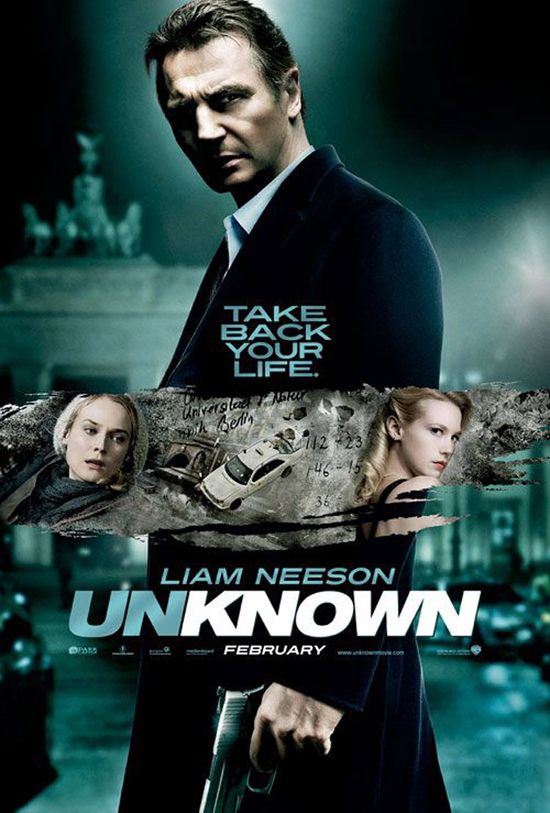
(REVIEW) Unknown: Uninspired

I must admit, I have a bit of a soft spot for Liam Neeson.  I was first became aware of him in fourth grade.  He was introduced to me in the manner most likely to grab my idolizing attention as an elementary schooler: I saw him play a jedi onscreen.  Though my taste in prequels as a wee lad of 10 was somewhat questionable, I retain a certain fondness for Liam Neeson's work.  You've got to harbor a little respect for a man with the versatility to portray Jean Valjean, Oskar Schindler, Alfred Kinsey, Zeus, Aslan, and Ra's al Ghul.  Recently, he's become more and more the action hero, starring in 2008's warmly recieved Taken and the critically-panned The A-Team reboot.  In Unknown he continues this trend, starring in what turns out to be a derivate amnesia tale with just barely enough interesting twists to make it watchable.


The movie opens with Dr. Martin Harris (Liam Neeson) arriving in Berlin to attend a conference with his wife, Elizabeth (January Jones).  On his way back to the airport to retrieve some forgotten luggage, Harris' taxi is forced off a bridge and suffers a head injury, erasing any recollection of the days events from his mind and putting him in a coma for four days.  When he returns the hotel to find his wife, he finds that she does not recognize him, and that she is accompanied by a man claiming to be the real Dr. Martin Harris.  Harris's memories of his past life are thrown into question, and he sets out to discover who he really is.

This first half-hour is the film's highpoint, in which Harris questions his identity and becomes increasingly paranoid about prying eyes, both real and imaged.  Once Harris discovers that people are indeed out to get him, the plot becomes formulaic and plays out similarly to The Bourne Identity.  Just as in The Bourne Identity, Harris quickly picks up a young female sidekick, and among car chases and small apartment stand-offs the conspiracy-riddled plot is eventually uncovered.

Neeson sells the role right off the bat, but seems like he's trying too hard at intensity in several scenes.  His emotional scale for all intents and purposes has two settings in this movie-- he's either calm and determined or barking out lines in a gravel-gargling rage.  Diane Kruger and Bruno Ganz play excellent supporting roles as illegal citizen Gina and Ernst Jurgen, respectively.  January Jones' portrayal of Mrs. Harris, however, is wooden and unconvincing.  When she attests that she's never seen her husband before, you don't believe her for a second, causing twists later on in the film to lose their dramatic impact.

The film works in several red herrings and acts of misdirection that  will most likely keep viewers on their toes, and it manages to do this while not letting these twists muddle up the story.  Sadly, many of the action sequences are sprinkled with unintentionally humorous moments that break the dramatic tension, such as cars that unnecessarily burst into flames or lines of dialogue where Neeson is trying way too hard to maintain an American accent.  

Despite its occasional moments of surprise, Unknown feels a little to derivative of other popular films in its bloated genre.  Neeson's star power helps keep the movie afloat, but don't expect to be walk out of the theater wowed by either its plot or presentation.  I'd recommend skipping the film in theaters.  Save it for a rainy-day Netflix viewing.

Thursday, February 17, 2011

(OT) 7 Deadly Sins- Dantescan Origins

Background: Dante's Inferno

Written records of the concept of the Seven Deadly Sins have been floating around as early as the 4th century.  Though the list has gone the some revisions over the years; however, the commonly accepted list nowadays goes: Lust, Gluttony, Greed, Sloth, Wrath, Envy, Pride.

The Deadly Sins as a pop culture icons  have their roots in the breakout religious-fiction text of 14th century Italy, Dante Aligheiri's Divine Comedy.  Throughout the Comedy's three books Dante takes a journey through the three spiritual realms, Inferno, Purgatorio, and Paradiso (that's Hell, Purgatory, and Heaven/Paradise for you non-Italian readers).   

Inferno was then, and is now, the standout text of the three.  After all, it's got all the good, juicy bits, right?  Rumor has it that after Dante had finished and distributed Inferno, he overheard a woman whispering to her companion as he passed through town one day.  "There goes the man who has toured the Abyss and yet still walks this earth," she said (or so the story goes).  Inferno had such a huge impact on Italian society that some thought its text be an entirely factual manifesto.

Modern Popularity Comparison: Forks, Washington residents don't actually believe in vampires.
Inferno's depiction of Hell consists of a series of nine circles.  Within each circle reside souls that were condemned for a particular sin; as Dante descends into the deeper circles of Hell, the sins being punished become more and more severe, while the circles become smaller and smaller.  For all intents and purposes, Hell is pretty much an infernal bathroom drain.  All the worst clogs congeal at the bottom.

Someone get us some Divine Drano.

As you may have guessed, within these nine circles all seven of the Deadly Sins are represented, each with a unique punishment befitting their crime.  Here they are, in order of Dante's descent into Hell.

In Purgatorio, the souls of the Saved who go through the process of Purgation work their way up seven terraces in their journey toward Heaven, each representing one of the Deadly Sins (in reverse order of how they are listed here).

Lust  

Francesca and Paulo, tragic adulterers condemned to the Second Circle.
The Lustful are the first of the Deadlys that Dante encounters.  Thus, this sin is seen by Dante to be the least severe of the seven.  The carnal souls are punished by being eternally blown around by a tempestuous storm, a metaphor for the raging passions that controlled their earthly lives.

In Purgatorio, those purging earthly lusts run through scalding flames while shouting out their sins.

Gluttony 


Immediately after escaping the stormy Second Circle, Dante happens upon the Gluttons.  These souls of wanton excess are forced to wallow in stinking mud and a ceaseless rainstorm, struck sightless and unaware of those around them for their selfish former lives.

In Purgatorio, those ridding themselves of gluttonous tendencies are emaciated and starving, tempted by trees with fruit that is always just out of reach.

Greed


In the Fourth Circle, Dante finds the Greedy to be split into two groups: The hoarders, who kept all that they could with no regard for others, and the prodigals, who squandered recklessly what wealth they had.  The two groups perpetually roll great stones with chests toward the stones of the other group, clashing together violently, unable to comprehend the other group's mentality in the least.

In Purgatorio, being cleansed of greed involves lying face-down, completely paralyzed, while reciting prayers against their covetousness.

 Sloth & Wrath


The Fifth Circle contains the river Styx. Below the river Styx's surface, constant streams of bubbles rising to the surface are the only indicator of the presence of the Slothful, submerged for all eternity into the riverbed.  Their laziness in life gives them no pleasure in Hell, trapped as they are below the churning depths

Upon the river's surface the Wrathful perpetually battle each other, never given respite from the anger and rage that consume their minds.

In Purgatorio, the slothful are cured by running ceaselessly, unable to pause for a short period.  The wrathful are trapped in endless clouds of smoke during their Purgation; the smoke symbolizes the blinding power of rage.

Envy & Pride 

The Giants of the Ninth Circle, symbols of pride.

The Envious and the Prideful are not designated to specific circles in Hell: these are more cerebral sins, and can manifest themselves in many different evil ways- thus, Envy and Pride can be attributed to many denizens of the lower Circles of Hell (The Violent, The Fraudulent, and the Treacherous).

In Purgatorio, erasing envy requires having the eyes sewn shut until there comes a point where the soul does not covet the possessions or achievements of others.  The prideful bear enormous stones on their backs continuously, exercising humility.

Wrap-up

Well, that's that: a solid foundational understanding of the first substantial use of the Seven Deadly Sins as a literary device.  In my next few entries I will be discussing how different mediums have evolved or implemented this thematic device to suit their purposes.

Coming up? It's the story of two brothers on a quest for redemption, and the seven malicious figures they encounter on the way.


*Pictures Compliments of: 
(Hell Map) http://whinecoloredsea.blogspot.com/2005_01_01_archive.html 
(All Others) www.wikipedia.com